Sunday, 13 November 2011

Hibachi Chicken

I bought my Hibachi a long time ago, I cant remember why.  It is a portable Japanese charcoal burner.  I hardly used it and kept lugging it around the country as I moved from vineyard to vineyard.  But after a holiday to Vietnam last year, I have a new found love for it.
Everywhere we went there was street food cooking over coal.  Coal, not coals, not charcoal, but coal dug from the ground and compressed into these heat cylinders.  
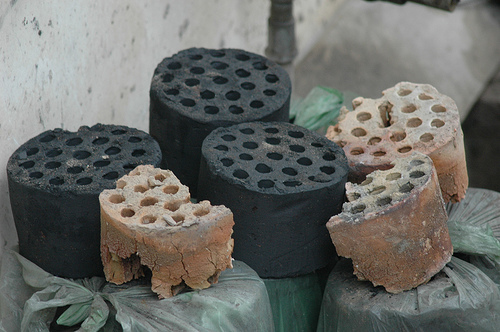
The sulphurous smell, mixed with the tropics and the wonderful foods was hedonism.  I just  had to emulate it as best as I could.  So I broke out the old rusty Hibachi and went to my local BBQ shop, grabbed some charcoal and went nuts.  The charcoal, created from heating/cooking wood, doesn't give that same third world aroma, but it is a pretty good approximation. Here is what we had last week, when summer appeared in Hobart, for a brief moment.

Hibachi Chicken
As usual we use only the best chicken, Nichols, but grab thighs.  Chicken breast meat is for pet food, it is dry and I have never had a good one.  Yes, breast is fat free, also flavour free.
Coat your chicken in a generous amount of Waji Cajun Meat Seasoning and marinate for awhile.  Don't have this in your cupboard? Why not!  It is the best spice mix, and very reasonably priced.  Also get your self one of these bbq racks (we got ours cheap from Chatuchuk):
Now lay each chicken thigh steak (dont chop your chicken up) on the grill and close it up.  Place it on the Hibachi, which has been lit half an hour in advance. 
Now you want to turn the chicken regularly as the coals will be (should be!) hot, and you want to avoid a black mess.  But brown crunchy bits are recommended.  Every time you turn the grill, undo it and knock the sticking chicken off the top section.  This will save you lots of pain when it comes to removing it.
Please don't over cook it, chicken so often is.  This should be cooked when it is firm, not hard, to compress.  Cut a bit open if you are unsure, it should be just cooked through.  Now plate up with your favourite accompaniment. We served our chicken with roast potato wedges and home garden salad.  Enjoy

Saturday, 5 November 2011

First Weekend Garden Club - November

It is the first weekend of the month and we are spending a lot of time in the garden.  The warmer weather is finally here and everything has taken off and is going nuts.  There is a massive amount of work on, and spending 2 weeks away on a holiday has not helped.  Here are my favourite photos for this month.  #firstweekendgardenclub

Herbs going nuts. Oregano, Sage (flowering) and Rosemary

Seedlings in the hot house reading for planting or updating to larger pots

Speckled lettuce. Great flavour, bolts least

The Peas marching on

Californian Poppies

Wednesday, 2 November 2011

Food Blogging with @StephenEstcourt, or how I learnt to love the Thermomix

This week on the show I chatted with Stephen Estcourt.  


He is a QC lawyer with a food habit, well it is better to describe him in his own words from his blog:
"I am a lawyer cum food tragic. My love of produce is powerful and inexplicable. It is more than cultural. It is an instinctive pull that rules my waking and my dreaming."
We had a great chat about what is involved in a food blog, how he got into it, and what he enjoys most about it.  But for the most of the show we ended up talking about this:


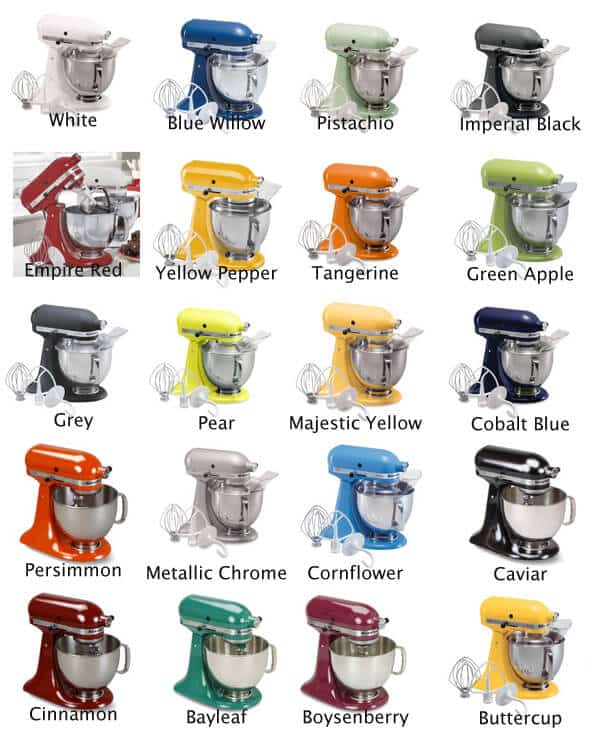
It is a Thermomix.  This nifty bench top machine can apparently chop, beat, mix, whip, grind, knead, mince, grate, juice, blend, heat, stir, steam and weigh food.  It seems like some miracle machine, and Stephen is absolutely in love with it.  Actually, when I chat with anyone who owns one these beasts (~$1,900) they can not get enough of them.  But I still love my simple bench top mixer, and won't be giving it up anytime soon, my KitchenAid:


Here is the audio with Stephen Estcourt:

Tuesday, 25 October 2011

The Dream of a Vineyard, The Nightmare of the Reality

Every office worker dreams it.  I am sure of it, not that I have ever worked in an office.  But the dream of "chucking it all in" and heading of for a tree change and plunging into the world of living off the land is very alluring.

Of course the dream of fleeing the office-scape for a vineyard is all to enticing.  Who would not want to wake up every morning, looking out over their sea of vines.  Spend a bit of the day in the vineyard, chat with guests in the cellardoor, an agrarian lunch on the patio, a siesta, then playing in the winery in the afternoon.  Maybe some friends over for dinner with a bottle of the 2001 vintage from the cellar, such a great year.


Sorry folks, it ain't like that.

First off, it is agriculture. The seasons play havoc, plans never stick, too little rain and you struggle, too much rain can destroy you.

Then, you have to sell it. This seems to be put way back in the minds of a lot of small producers. It reminds me of a 1989 movie with Kevin Costner, Field of Dreams. The main punch line of this movie is "build it and he will come". Kevin builds himself a baseball field and people flock to his door.


Well it does not work this way for a small producer. You don't just make a wine and then it sells. People will not "just come". It takes a lot of hard work and marketing to be successful in selling wine.

And this week on the show I have spoken to 2 young winemakers Paul and Gilli, full of optimism and punch.  They have recently bought a vineyard and are renovating it with the aim of producing their own wine.  After a year they understand how hard it is, how high the highs can be and how heart wrenching the lows can be.  And with Paul's marketing background I hope they succeed and don't fall into the traps others have.

Here is the audio:


Thursday, 20 October 2011

Roast Chook, RÖMERTOPF®

RÖMERTOPF... Hmmm, you say.  Well it was cool when I was a little tacker, I think.  It was cool before the Tagine was cool.  It is way cool.


It is a German clay pot for cooking in the oven, and it has no vent like the tagine so all the moisture stays in.  We found ours at the op shop (steal!) and have used it to great success quite a few times.


Normally for a roast chook we follow Stephanie Alexanders method in the bible (The Cook's Companion), 160°C for 1h20m rotating every 20 min with butter and lemon up the bum.  A great method and fantastic results.


But this week we used the RÖMERTOPF.  


Recipe

  • Soak RÖMERTOPF in cold water for 10 minutes minimum

  • Pat dry chook (We recommend Nichols)

  • Place in RÖMERTOPF on top of baby potatoes (and any other roast vegies you like)
  • Baste outside of chook with ginger, salt, pepper, olive oil

  • Place into COLD oven and turn oven on to 160°C
  • It should cook in 1.5-2 hours (depending on the heating time of the oven, everyone is different)
Serve with the roast vegies and steamed garden greens, enjoy.


Tuesday, 18 October 2011

Whisky/Whiskey

Whisky, or is it Whiskey?  I can never remember the difference.  And reading Wikipedia only makes it more confusing:
The spelling whisky (plural: whiskies) is generally used in Canada, Japan, Scotland, and Wales, while whiskey (plural: whiskeys) is more common in Ireland and the United States. However, the usage is not always consistent – for example, some prominent American brands, such as George DickelMaker's Mark, and Old Forester (which are all made by different companies), use the 'whisky' spelling on their labels, and the U.S. legal Standards of Identity for Distilled Spirits document also uses the 'whisky' spelling. American brands using the Scottish version of the spelling of “whisky” tend to have been founded by individuals with Scottish ancestry or to have a flavour, style or marketing strategy that is evocative of Scotch whisky.
From here on I will use Whisky, it will save me one keystroke.

Whisky is made by first of all fermenting a grain (barley, rye, malted or un-malted) which is very similar to another process, beer.  This alcoholic liquid (beer?) is then distilled a couple of times to get it up to cask strength, 63-72% alcohol.  This is then stored in casks for a period of time prior to bottling.  Simple hey.

So I know little about this art and thought I should get someone into the studio who knew a lot more about it than me.  Enter Bill Lark.


He has been making distilled spirits in Tasmania at Lark Distillery for quite a while.  In fact he was the first distillery in Tasmania for 150 years, and had to battle federal laws to get it up and running.  Fascinating story, I had a great time, thanks Bill.

Here is the audio:


Podcast Powered By Podbean

Saturday, 15 October 2011

That WET Debate, Rebate, Part 2.0

The Rebate is not Married to the Tax

You may have or not read my previous post on the Wine Equalisation Tax and may agree or disagree with my view that the small winemaker will not be affected much by changing the tax on wine from Ad Valorem to Volumetric.

After chatting with many boutique operators I always get the same response:
"But if the WET goes I won't get my rebate"
I want to analyse this phrase and break it down in to what we are talking about.  There are actually 2 separate parts to the current wine tax system, but for some reason they have become "married".  They are:
  1. A tax on wine. Currently a Wine Equalisation Tax (WET) of 29% then GST of 10%
  2. A rebate.  For the first $1,000,000 of sales you get the WET tax back
How does changing the Tax change the Rebate?  The fear is that "if the Government change the tax system, it will all go".  Maybe, but what if it doesn't.  Why can't the tax system look like this:
  1. A tax on wine. Volumetric tax at the rate of $0.16 per standard drink
  2. A rebate.  For the first $1,000,000 of sales you get the Volumetric tax back
I would love to see the divorce of the thinking that to "have a rebate you have to have a WET". And with this new system, every small winemaker (below $1,000,000 of sales) would pay exactly the same rate of tax, the GST 10%.  

It is right for the wine industry to have a tax rate based on the volume of alcohol, as it can be such a damaging drug in the wrong hands.  I want this debate to continue.

Thoughts?